
Executive Summary
Take Action Lab (TAL), an initiative by Tilting Futures, has consistently demonstrated its capacity to equip young adults with the knowledge and networks necessary to transition from passive awareness of social issues to active, purposeful participation. While previous research established this transformative impact within our inaugural site in South Africa, new data indicates that the TAL model is fundamentally scalable. These latest findings suggest the program maintains its core efficacy across diverse geographic regions, cultural contexts, and social themes.
Background
Take Action Lab (TAL) transforms passive awareness into active global citizenship. By anchoring systems-thinking in self-reflection and real-world application, the program equips young adults to better understand themselves and their international peers. This foundation empowers students to respectfully and effectively navigate complex global social issues.
Built upon 15 years of experimentation in global immersion education, TAL officially launched in January 2023. The inaugural program was based in South Africa with a focus on Human Rights, followed by a second site launched in Malaysia in August 2025 centered on Environment & Sustainability.
The Take Action Lab Program Model
The program follows a structured curriculum designed for deep impact:
- Pre-Departure: Coursework covering systems thinking, host country context, cohort community-building and cultural self-awareness.
- In-Country Immersion: Orientation, co-living with a global cohort, and hands-on apprenticeships at local NGOs.
- Reflection & Transition: Facilitated reflection sessions, a dedicated “reflection week,” and post-program support to help students transition home and apply their learning.
- Lifelong Engagement: Ongoing access to changemaking workshops and a global peer network.
Validated Impact: A Proven Blueprint for Changemaking
Externally-validated studies have shown that Take Action Lab: South Africa develops students’ relational intelligence and global citizenship¹. Specifically, measurable gains were detected in areas of:
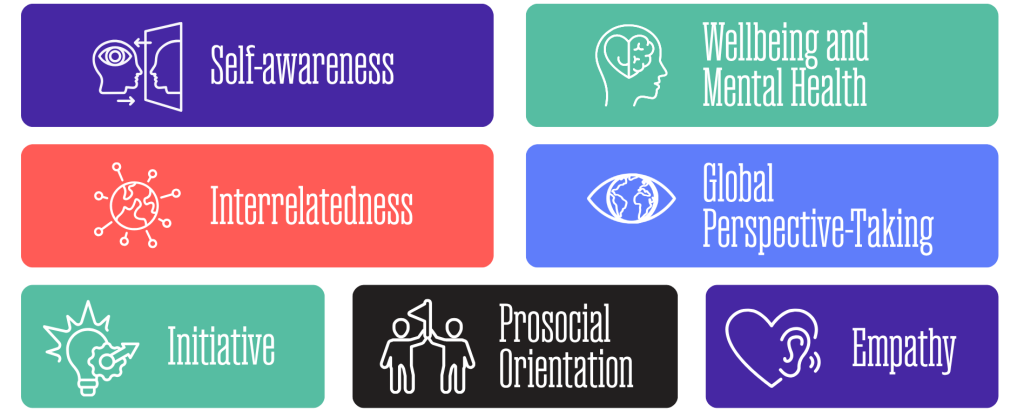
Students also grew in leadership competencies of adaptability, resilience, and open-mindedness.
¹Some of these results have been published in the Intercultural Connector (June 2024) and on the Tilting Futures website here and here.
Beyond Borders: Testing for Scalability
Does Impact Translate Across Contexts? To assess the generalizability of the Take Action Lab pedagogical framework, researchers conducted a cross-site study using a longitudinal, repeated-measures design. By evaluating students in both South Africa and Malaysia at two distinct time points, researchers measured the model’s ability to drive student growth across varied contexts. The results provide robust evidence of the Take Action Lab model’s scalability: students at both sites grew by a statistically significant margin in core competencies, validating that the TAL model effectively cultivates global citizenship regardless of the context and setting.
Conscious Citizenship & Relational Intelligence
Despite the various contexts and thematic foci TAL students experienced as part of their program participation, researchers saw that TAL students grew by a statistically significant margin in each of the core Take Action Lab competencies related to relational intelligence and conscious citizenship: self awareness, wellbeing + mental health, intercultural exchange + perspective taking, interrelatedness, empathy and initiative.
Skills That Never Expire
TAL students also grew by a statistically significant margin in many of the skills that never expire and are necessary for succeeding in tomorrow’s workforce: open mindedness, resilience, action-orientation, analytical thinking, curiosity, flexibility, and systems thinking.
College and Career Readiness
Take Action Lab also effectively equips students for their next life stage, significantly enhancing both college and career readiness.
The program provides a clear academic roadmap, with 87% of participants reporting a better understanding of their educational goals as a result of the experience.
Longitudinal research across both program sites demonstrates that students are statistically better prepared for college following their participation. Specifically, graduates showed a marked increase in their ability to:
- Navigate emotional challenges, including self-advocacy and the transition of living away from family.
- Proactively maximize their undergraduate experience.
- Define clear objectives for what they intend to achieve during their college years.
TAL also serves as a powerful catalyst for professional growth. Seventy-seven percent of graduates reported gaining critical job-related skills, a figure that significantly outperforms traditional higher education settings. By comparison, the National Survey of Student Engagement (NSSE) reports that only 54% of undergraduate students at four-year colleges feel they have gained similar skills. Furthermore, 80% of students also indicated that TAL helped them clarify their professional goals, providing them with a competitive advantage as they enter the workforce.
Conclusion
Through a longitudinal, repeated-measures design, this research confirms that Take Action Lab (TAL) successfully transforms global awareness into activated citizenship. By proving this program is both modular and adaptable, Tilting Futures has validated a curriculum that consistently supports young adults in transitioning from observers to changemakers. This effectiveness remains stable across diverse cultural contexts and thematic frameworks, from civic innovation in South Africa to sustainability in Malaysia, demonstrating that the program’s impact is replicable and generalizable.
Beyond traditional academic knowledge, TAL cultivates essential competencies such as systems thinking, resilience, and adaptability; skills that are often difficult to develop in a standard classroom setting. The statistically significant growth in these areas ensures that participants leave the program as motivated citizens equipped with the self-awareness, initiative, and intercultural perspective-taking required for tomorrow’s world. Ultimately, TAL offers a proven blueprint for building students’ skills to navigate global complexities through a respectful, civically-minded lens.
In the next phase of Tilting Futures research, studies will focus on two primary objectives: the continued longitudinal validation of the TAL pedagogical model and an investigative expansion into the “network effects” of TAL alumni on their broader residential, institutional, academic and social communities. While initial findings confirm the program’s ability to transform individual students, Tilting Futures is now interested in understanding how these “activated” young adults serve as catalysts for change. Ultimately, this phase will determine if the TAL model can be leveraged not just for individual growth, but as a strategic tool for driving systemic, community-wide cultural shifts toward active global citizenship.

Holly Carmichael Djang is the Tilting Futures Sr. Director of Research & Impact. She comes to Tilting Futures with over 20 years of helping organizations make data-informed programmatic decisions and apply complex and rigorous methodologies to understand organizational impact.